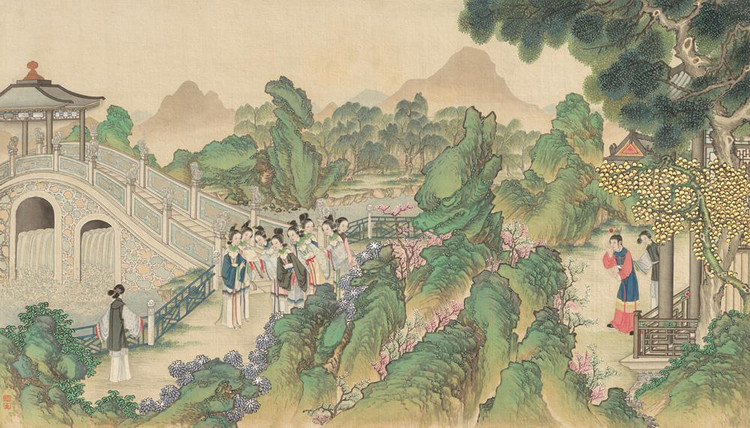
Understanding Wen in Eastern Literature and the theme of spiritual connections
This week’s readings centered around poetic pieces and literary elements that are not commonly seen in Western literature. Wen is one of those literature elements. Have them read the excerpt by Longxi to help further the understanding of what Wen means and how it can be found in both stories. There is a strong connection to the spiritual world in Eastern culture and it can be seen in the literature.
What is wen and why is it made so terribly strange? By: Longxi, Zhang
STUDENT ACTIVITY
Arrange students desk in a circle. This promotes better discussion methods. Spend the first 15-20 minutes going over what Wen is. Wen can be a hard concept to wrap one’s mind around but it also highlights the cultural differences between Western and Eastern literature. Have the students think about the differing literary elements that they commonly see in Western literature.
What is Wen?
“To accomplish wen is, finally, in the simplest terms, to accomplish the ability to communicate fully and powerfully.” (Seaton, 2006) http://poetrychina.net/poeticspage/wen
Wen can be a hard concept to wrap one’s mind around. It is different from Western Literature and things that are different can be hard to understand. Wen in Chinese literature was the ultimate form of communication as it studies objects in nature and also patterns of nature. It is extremely different from Western Literature and it could be as hard as learning a new language when it comes to viewing literature from different cultural perspectives.

Wen is not imaginative or of fictional creation. It is transcendence. Transcendence is existence beyond the physical world. A Western cultural comparison could be found in the movie Transcendence with Johnny Depp starring. Chinese literature taps into the universe for its answers and explanations. It uses nature for forms of expression in the arts. Wen is the outwardly form of what is felt within brought to poetry, music, or other forms of art. It is a manifestation.
“…influence on the study of Chinese literature in the West and have helped shape a notion of that literature as something fundamentally different from what is usually understood as imaginative or fictional creation.” (Longxi, 1996)
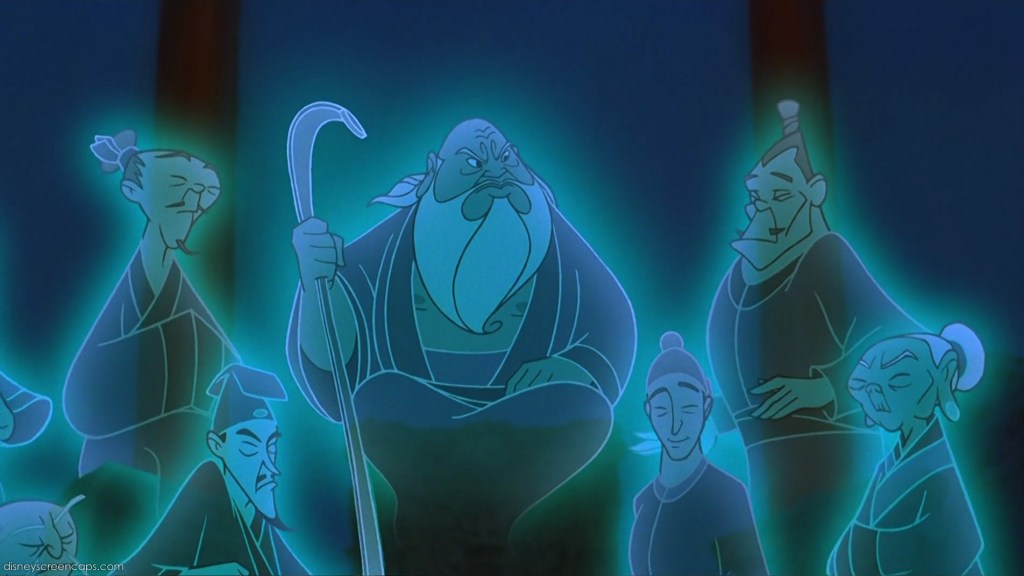
Another cultural comparison can be made by bringing up a popular Disney movie. Everyone knows the movie Mulan and it is shows some of that relationship of the spiritual world within the real world as seen with the elders within the movie. Once they watch a few scenes from the movie, have them think of how they can see Wen within the movie and then move onto this week’s readings.
Discussion questions
- Why is Chinese literature so different from Western literature? Is it because they have a more spiritual connection to the world in their art?
- Is Western literature less advanced than Chinese literature?
- What is a heavy influence found in Chinese literature? For example, a heavy influence in Western literature is Hebrew culture.
- What ways did you seen Wen in Mulan?
Teaching Wen in the classroom
For teaching Wen in the classroom, there can be various activities that can be done. Have the students analyze these two poems below and ask how Wen would be used in the analysis of one of the poems. The student will pick ONE poem and explain their understanding of wen against the poem.
“Peach tree soft and tender,
how your blossoms glow!
The bride is going to her home,
she will befits this house.
Peach tree soft and tender,
plump, the ripening fruit.
The bride is going to her home,
she well befits this house.
Peach tree soft and tender,
its leaves spread thick and full.
The bride is going to her home,
she well befits these folk.”
“A roe deer dead in the meadow,
all wrapped in white rushes.
The maidens heart was filled with spring;
a gentleman led her astray.
Undergrowth in forest,
deer dead in the meadow,
all wound with white rushes,
a maiden white as marble.
Softly now, and gently, gently,
do not touch my apron, sir,
and don’t set the cur to barking.”
Works cited
“Classic of Poetry.” The Norton Anthology of World Literature, edited by Martin Puchner, Shorter 3rd ed., Vol. 1. New York: Norton, 2013, pp.1317-1321.
Longxi, Z. (1996). What is wen and why is it made so terribly strange? College Literature, 23(1), 15. Retrieved from https://search-ebscohost-com.lopes.idm.oclc.org/login.aspx?direct=true&db=ehh&AN=9603264011&site=ehost-live&scope=site
Seaton, J. (2006). Wen – Poetry in Chinese Culture. Retrieved from http://poetrychina.net/poeticspage/wen
 Multi-Cultural Literary Blog